Friday, July 25, 2014

Genital Psoriasis Homeopathy Specialty Treatment at Chennai


Genital Psoriasis
The most common type of psoriasis in the genital region is inverse psoriasis. This type of psoriasis first shows up as smooth, dry, red lesions. It usually lacks the scale associated with plaque psoriasis.

There are various regions of the genital area that can be affected by psoriasis:
¬  Pubis: The pubis is the region on males and females above the genitals. This area can be treated similarly to psoriasis on the scalp; however, use caution. Skin in the pubic region is more sensitive than the skin on the scalp.
¬  Upper thighs: Psoriasis on the upper thighs often consists of many small, round patches that are red and scaly. Psoriasis in between the thighs is easily irritated, especially if the thighs rub together when you walk or run.
¬  Creases between thigh and groin: Psoriasis generally appears as non-scaly and reddish-white in the creases between the thigh and groin. The skin may have fissures (cracks). People who are overweight or athletic may have an infection called intertrigo, which looks similar to a yeast infection in the folds of the skin.
¬  Genitals: Psoriasis of the vulva often appears as a smooth, non-scaly redness. Scratching this area may cause an infection, create dryness, and result in thickening of the skin and further itching. Genital psoriasis usually affects the outer skin of the vagina because psoriasis does not normally affect mucous membranes. In general, genital psoriasis does not affect the urethra.

Psoriasis of the penis may appear as many small, red patches on the glans, or shaft. The skin may be scaly or smooth and shiny. Genital psoriasis affects both circumcised and uncircumcised males.
¬  Anus and surrounding skin: Psoriasis on or near the anus is red, non-scaly and prone to itchiness. Psoriasis in this area may be confused with yeast, infections, hemorrhoidal itching and pinworm infestations. The presence of these conditions can complicate the treatment of psoriasis. Rectal examinations and skin cultures can confirm these conditions. Symptoms of anal psoriasis may include bleeding, pain during bowel movements, and excessive dryness and itching.
¬  Buttocks crease: Psoriasis in the buttocks crease may be red and non-scaly or red with very heavy scales. The skin in this area is not as fragile as that of the groin.

Treatment
Genital psoriasis can be difficult and frustrating to treat. However, it generally responds well to treatment. Due to the sensitivity of genital skin, treatment requires some special consideration. It is important to remember that response times to treatments vary among individuals.


Symptomatic Homeopathy Medicines works well for Genital Psoriasis 


==--==

Erythrodermic Psoriasis


 psoriasis specialist treatment hospital chennai, tamilnadu, india


Erythrodermic Psoriasis
Erythrodermic psoriasis is a particularly inflammatory form of psoriasis that often affects most of the body surface. It may occur in association with von Zumbusch pustular psoriasis.

It is a rare type of psoriasis, occurring once or more during the lifetime of 3 percent of people who have psoriasis. It generally appears on people who have unstable plaque psoriasis. This means the lesions are not clearly defined. Widespread, fiery redness and exfoliation of the skin characterize this form. Severe itching and pain often accompanies it.

Individuals having an erythrodermic psoriasis flare should see a doctor immediately. This form of psoriasis can be life-threatening.

Symptoms
Ø  Severe redness and shedding of skin over a large area of the body
Ø  Exfoliation often occurs in large "sheets" instead of smaller scales
Ø  Skin looks as if it has been burned
Ø  Heart rate increases
Ø  Severe itching and pain
Ø  Body temperature goes up and down, especially on very hot or cold days

Erythrodermic psoriasis "throws off" the body's chemistry. This causes protein and fluid loss that can lead to severe illness. Edema (swelling from fluid retention), especially around the ankles, may develop, along with infection. The body may not be able to maintain its temperature. This can produce shivering episodes. Erythrodermic psoriasis also can bring on pneumonia and congestive heart failure. People with severe cases often require hospitalization. Erythrodermic psoriasis can occur abruptly at the first signs of psoriasis or it can come on gradually in people with plaque psoriasis. The reason erythrodermic psoriasis appears is not understood. However, there are some known triggers.

Triggers        
Ø  Abrupt withdrawal of systemic treatment
Ø  Severe sunburn
Ø  Allergic, drug-induced rash that brings on the Koebner phenomenon (a tendency for psoriasis to appear on the site of skin injuries)
Ø  Use of systemic steroids (cortisone)
Ø  Infection
Ø  Emotional stress
Ø  Alcoholism

Treatment
ü  Systemic medications are most effective and usually are required to bring severe cases under control.
ü  Combination treatments are frequently required, meaning using topical products and one or two systemic medications.
ü  Once the erythrodermic psoriasis flare passes, the psoriasis usually reverts to the way it looked before the flare. Some health care providers may prescribe pain medications, as this is an especially painful condition. Medication for itch, anxiety or sleep may also be prescribed if appropriate.


==--==

Psoriasis Differential Diagnosis


 scalp psoriasis specialist dr.sendhil kumar chennai 9786901830


Differential Diagnosis

Guttate psoriasis may be confused with:
¬  Discoid dermatitis (more itch, vesicles, dry rather than plate-scale)
¬  Tinea corporis (elevated border, slowly extending edge, positive mycology)
¬  Pityriasis rosea (herald patch, fir-tree distribution of oval plaques, trailing scale)

Erythrodermic psoriasis may be confused with:
¬  Erythrodermic atopic dermatitis (intense pruritus, exudative )
¬  Drug eruption (due to drug commenced within prior 8 weeks)
¬  Pityriasis rubra pilaris (cephalo-caudal spread, follicular prominence)

Generalised pustular psoriasis may be confused with:
¬  Acute generalised exanthematic pustulosis (drug eruption that rapidly settles with withdrawal of drug, also known as ‘AGEP’ and more common in those with known psoriasis)
¬  Bacteraemia and bacterid: cutaneous pustules arising during gram positive and gram negative septicaemia
¬  Infected generalised atopic and/or seborrheic dermatitis
¬  Pityriasis rubra pilaris
¬  Reiter syndrome
¬  Folliculitis


==--==

Friday, July 18, 2014

Psoriasis Triggers


 psoriasis specialist doctor in tamilnadu, india, specialty hospital for psoriasis


Psoriasis Triggers
Researchers believe that for a person to develop psoriasis, the individual must have a combination of the genes that cause psoriasis and be exposed to specific external factors known as "triggers". 

Psoriasis triggers are not universal. What may cause one person's psoriasis to become active, may not affect another.

Some Psoriasis triggers include:
Stress
Ø  Stress can cause psoriasis to flare for the first time or aggravate existing psoriasis. Relaxation and stress reduction may help prevent stress from impacting psoriasis.

Injury to skin
Ø  Psoriasis can appear in areas of the skin that have been injured or traumatized. This is called the Koebner  phenomenon. Vaccinations, sunburns and scratches can all trigger a Koebner response. The Koebner response can be treated if it is caught early enough.

Medications
Certain medications are associated with triggering psoriasis, including:
Ø  Lithium: Used to treat manic depression and other psychiatric disorders. Lithium aggravates psoriasis in about half of those with psoriasis who take it.
Ø  Antimalarials: Plaquenil, Quinacrine, chloroquine and hydroxychloroquine may cause a flare of psoriasis, usually 2 to 3 weeks after the drug is taken. Hydroxychloroquine has the lowest incidence of side effects.
Ø  Inderal: This high blood pressure medication worsens psoriasis in about 25 percent to 30 percent of patients with psoriasis who take it. It is not known if all high blood pressure (beta blocker) medications worsen psoriasis, but they may have that potential.
Ø  Quinidine: This heart medication has been reported to worsen some cases of psoriasis.
Ø  Indomethacin: This is a nonsteroidal anti-inflammatory drug used to treat arthritis. It has worsened some cases of psoriasis. Other anti-inflammatories usually can be substituted. Indomethacin's negative effects are usually minimal when it is taken properly. Its side effects are usually outweighed by its benefits in psoriatic arthritis.

Infection
Ø  Anything that can affect the immune system can affect psoriasis. In particular, streptococcus infection (strep throat) is associated with guttate psoriasis. Strep throat often is associated with the first onset of guttate psoriasis in children. You may experience a flare-up following an earache, bronchitis, tonsillitis or a respiratory infection, too.
Ø  It's not unusual for someone to have an active psoriasis flare with no strep throat symptoms.
Ø  Although scientifically unproven, some people with psoriasis suspect that allergies, diet and weather trigger their psoriasis. Strep infection is known to trigger guttate psoriasis.


==--==

Friday, July 15, 2011

Psoriasis Information and Treatment - Homeopathy

Psoriasis is a chronic skin disease that causes skin cells to grow too quickly. In psoriasis, patches of red, thickened skin with silvery scales develop, usually on the elbows, knees, scalp, and trunk. These areas can be itchy and painful. The areas usually involved are the elbows, knees, and the skin behind the ears, the trunk, and the scalp. The disease may also affect the underarms and genital areas.

Nails may become rough and pitted, and less commonly, a form of arthritis develops called psoriatic arthritis. Psoriasis can be a persistent problem, and tends to run in families. Stress, infections such as a sore throat, reaction to certain drugs, and skin injuries may trigger an attack or make it worse.

Symptoms of Psoriasis

Following are the major psoriasis symptoms:

1. Red and irritated skin with bright silvery scales
2. Sometimes accompanied with slight itching

Causes of Psoriasis

Following are the major psoriasis causes:

1. Due to abnormality in the mechanism in which the skin grows and replaces itself
2. Abnormality with the metabolism of amino acids
3. Use of certain medicines
4. Due to infections
5. Heredity factors are also responsible
6. Physical and emotional stress

Plaque psoriasis

·         Psoriasis is a very diverse skin disease that appears in a variety of forms. Each form has distinct characteristics. Typically, people have only one type of psoriasis at a time, but occasionally two or more different types of psoriasis can occur at the same time. Psoriasis can also occasionally change from one form to another. Trigger factors may "convert" some forms of psoriasis, such as plaque, to another form, such as pustular. Generally, one type of psoriasis will clear and then another form of psoriasis will appear later.
·         Plaque psoriasis is the most prevalent form of the disease. Its scientific name is psoriasis vulgaris (vulgaris means common). It is characterized by raised, inflamed, red lesions covered by a silvery white scale. It is typically found on the elbows, knees, scalp and lower back.


Guttate psoriasis

·         Guttate psoriasis is a form of psoriasis that often starts in childhood or young adulthood. The word guttate is from the Latin word meaning "drop." This form of psoriasis resembles small, red, individual spots on the skin. Guttate lesions usually appear on the trunk and limbs. These spots are not usually as thick as plaque lesions.
·         Guttate psoriasis often comes on quite suddenly. A variety of conditions have been known to bring on an attack of guttate psoriasis, including upper respiratory infections, streptococcal infections, tonsillitis, stress, injury to the skin and the administration of certain drugs (including anti malarial and beta-blockers). A streptococcal infection of the throat (strep throat) is a common guttate psoriasis trigger. Strep throat can be present without symptoms and can still cause a flare of guttate psoriasis. Talk with your doctor about getting a strep test to determine if you have an underlying strep infection. Guttate psoriasis may persist despite clearance of the strep infection. Some doctors prescribe antibiotics to help prevent an occurrence of an infection that can cause the outbreak of guttate psoriasis.


Inverse psoriasis

·         Inverse psoriasis is found in the armpits, groin, under the breasts, and in other skin folds around the genitals and the buttocks. This type of psoriasis first shows up as lesions that are very red and usually lack the scale associated with plaque psoriasis. It may appear smooth and shiny. Inverse psoriasis is particularly subject to irritation from rubbing and sweating because of its location in skin folds and tender areas. It is more common and troublesome in overweight people and people with deep skin folds.


Erythrodermic psoriasis

·         Erythrodermic psoriasis is a particularly inflammatory form of psoriasis that often affects most of the body surface. It may occur in association with von Zumbusch pustular psoriasis. It is characterized by periodic, widespread, fiery redness of the skin. The erythema (reddening) and exfoliation (shedding) of the skin are often accompanied by severe itching and pain.
·         Patients having an erythrodermic psoriasis flare should make an appointment to see a doctor immediately. Erythrodermic psoriasis causes protein and fluid loss that can lead to severe illness. Oedema (swelling from fluid retention), especially around the ankles, may also develop along with infection. The body's temperature regulation is often disrupted, producing shivering episodes. Infection, pneumonia and congestive heart failure brought on by erythrodermic psoriasis can be life threatening. People with severe cases of this condition often require hospitalization.
·         Known triggers of erythodermic psoriasis include abrupt withdrawal of systemic treatment; the use of systemic steroids (cortisone); an allergic, drug-induced rash that brings on the Koebner response (a tendency for psoriasis to appear on the site of skin injuries); and severe sunburns.

Pustular psoriasis

·         Primarily seen in adults, pustular psoriasis is characterized by white pustules (blisters of non-infectious pus) surrounded by red skin. The pus consists of white blood cells. It is not an infection, nor is it contagious. It may be localized to certain areas of the body–for example, the hands and feet. Pustular psoriasis also can be generalized, covering most of the body. It tends to go in a cycle–reddening of the skin followed by formation of pustules and scaling.
·         Pustular psoriasis reportedly may be triggered by internal medications, irritating topical agents, overexposure to UV light, pregnancy, systemic steroids, infections, emotional stress and sudden withdrawal of systemic medications or potent topical steroids.

Types of pustular psoriasis

Von Zumbusch

·         The onset of von Zumbusch pustular psoriasis can be abrupt. Widespread areas of reddened skin develop, and the skin becomes painful and tender. Within a few hours, the pustules appear. The pustules then dry and peel over the next 24 to 48 hours, leaving the skin with a glazed, smooth appearance. A fresh crop of pustules may then appear. Eruptions often come in repeated waves that last days or weeks.
·         Von Zumbusch pustular psoriasis rarely appears in children, although when it does, the prospect of improvement may be much better than for adults.
·         Von Zumbusch pustular psoriasis is associated with fever, chills, severe itching, dehydration, a rapid pulse rate, exhaustion, anaemia, weight loss and muscle weakness. The goal of treatment is to restore the skin's barrier function, prevent further loss of fluid, stabilize the body's temperature and restore the skin's chemical balance. Chemical imbalances can put excessive stress on the heart and kidneys, especially in older people.
·         Because this form can be life-threatening, medical care must begin immediately. If you can't get in to see your doctor, you should go to the emergency room to get treatment. People with von Zumbusch pustular psoriasis often require hospitalization for rehydration and initiation of topical and systemic treatments, which typically include antibiotics.


Palmo-plantar pustulosis

·         Palmo-plantar pustulosis (PPP) is a type of pustular psoriasis that causes pustules on the palms of the hands and soles of the feet. PPP is characterized by multiple pencil eraser-sized pustules in fleshy areas of the hands and feet, such as the base of the thumb and the sides of the heels. The pustules appear in a studded pattern throughout reddened plaques of skin, then turn brown, peel and become crusted. The course of PPP is usually cyclical, with new crops of pustules followed by periods of low activity.
·         Those who are at risk for PPP should seriously consider not smoking, as some studies suggest that these patients may have an abnormal response to nicotine which can trigger flares of PPP.


Acropustulosis (acrodermatitis continua of Hallopeau)

·         This rare type of psoriasis is characterized by skin lesions on the ends of the fingers and sometimes on the toes. The eruption occasionally starts after an injury to the skin or infection. Often the lesions are painful and disabling, producing deformity of the nails. Occasionally bone changes occur in severe cases. This form has traditionally been hard to treat. Topical preparations that are occluded may help some patients. Systemic medications have been used with some success in clearing the lesions and restoring the nails.


Genital psoriasis

·         Psoriasis can occur in the genital area at the same time it occurs elsewhere on the body, or it can appear in the genital area only. People with genital psoriasis may have affected areas that range from small, red spots to large patches.
·         The most common type of psoriasis in the genital region is inverse psoriasis.


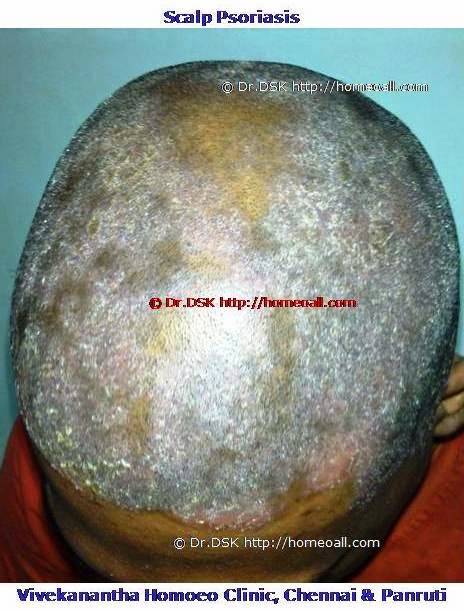
Scalp psoriasis

·         Scalp psoriasis is very common. In fact, at least half of all people who have psoriasis have it on their scalp. As with psoriasis elsewhere on the body, skin cells grow too quickly on the scalp and cause red lesions covered with scale to appear.
·         Scalp psoriasis can be very mild, with slight, fine scaling. It can also be very severe with thick, crusted plaques covering the entire scalp, which commonly can cause hair loss. Psoriasis can extend beyond the hairline onto the forehead, the back of the neck and around the ears (a common area). Most of the time, people with scalp psoriasis have psoriasis on other parts of their body as well. But for some, the scalp is the only affected area.


For Direct Consultation
Please Visit

Vivekanantha Homoeo Clinic & Psychological Counselling Centre
Consulting Homoeopath & Psychologist

Chennai Camp
(Consultation by Appointment only)
Every Sunday: - 11.00 am to 04.00 pm
At
Sri Chakra Flats
No.54-F3 vijaya nagar 3rd Main road
Velachery
Chennai-42
(Nearby Vijayanagar Bus Terminus)

NB:-
Ø  We are taking only minimum number of patients per day.
Ø  We are allotting 40 to 5o minutes for new patients & 15 to 20 minutes for follow-ups.
Ø  So be there at time to avoid unwanted waiting
Ø  For Psychological consultation “we concentrate more to client’s privacy, so we are allotting 40 to 50 minutes/client – so be there at time”

For Appointment
Please call: 09443054168, 09786901830

For Foreign patients & Online Treatment
For more detail and mode of payment
Send mail to consult.ur.dr@gmail.com
Or
Call +91 9443054168, +91 9786901830

Main Clinic
Vivekanantha Homoeo Clinic & Psychological Counselling Center
No.8.Rajaji Salai (Near Valli Villas Jewellery),
Panruti-607106,
Cuddalore district,
Tamil nadu,
India

Timings
Monday to Saturday
10.30 am to 12.45 pm & 05.30 pm to 9.00 pm

For Appointment
Please call: 09443054168, 09786901830
(Sunday Consultation by Appointment only)


Professional secrecy will be maintained
(Your complaints and other Details should be kept very confidential)




Please Contact for Appointment

Clinic & Camp Clinics


For Direct Consultation Please visit


Chennai - Head Office

(Consultation by Appointment only)

Vivekanantha Homeo Clinic & Psychological Counseling Center

B-12, Second Floor, Paramount Park (Dr Plaza) - B Block,

Velachery Main Road,

Direct Opposite to Saravana Stores, Mega mart upstairs,

Near Vijaya nagar Bus Stand,Velachery, Chennai 42,


Panruti – Branch Office

Vivekanantha Homoeo clinic & Psychological Counseling Center

126,Chennai Salai

( Near Railway Gate, Lakshmi Villas Bank ATM Direct Opposite)

Panruti 607106

Cuddalore District

Tamilnadu


For Appointment

Please call: 09443054168, 09786901830


Pondicherry Camp

(Consultation by Appointment only)

Every Saturday:11.00am to 04.00pm


NB:-

Ø We are taking only minimum number of patients per day.

Ø We are allotting 40 to 5o minutes for new patients & 15 to 20 minutes for follow-ups.

Ø So be there at time to avoid unwanted waiting

Ø For Psychological consultation “we concentrate more to client’s privacy, so we are allotting 40 to 50 minutes/client – so be there at time”


For Appointment

Please call: 09443054168, 09786901830


For Foreign patients

For more detail and mode of payment

Send mail to consult.ur.dr@gmail.com

Or

Call +91 9443054168, +91 9786901830


http://homeoall.com/

Professional secrecy will be maintained

(Your complaints and other Details should be kept very confidential)


--==--